The Problem
The original 1995 concrete driveway had cracked in multiple locations along its full length by the time we were called. The two most significant cracks ran diagonally from the apron corners toward the center at the garage end - classic corner stress fractures that appear when a slab is poured without adequate control joint placement or when the sub-base settles unevenly. Additional random cracking had developed through the middle section, and the apron had a 3/4-inch step at the street edge where the slab end had settled relative to the road.
The original pour had no visible tooled control joints. In a Chicago-area climate where the ground freezes to depth every winter, a slab without control joints concentrates thermal and shrinkage stress at random weak points - which is exactly what had happened over 30 years. Patching the existing cracks was not viable given the volume of cracking and the apron settlement issue.
Our Solution
Day one was full demolition. We removed the existing concrete with a skid-steer-mounted hydraulic breaker, hauled the rubble, and graded the sub-base. The existing stone base was in acceptable condition but had been disturbed during breaking, so we re-graded, added 2 inches of compactable gravel to low spots, and compacted to a firm, uniform base before forming.
The new concrete specification was 4,000 PSI with air entrainment - the air entrainment is the critical component in this climate. Air-entrained concrete contains microscopic air voids that give water room to expand when it freezes within the concrete matrix, reducing the internal stress that causes surface scaling and spalling through freeze-thaw cycles. Standard non-air-entrained concrete in a northern Illinois driveway application will begin scaling within 5-10 years.
We poured the driveway in two sections to allow working time in warm September conditions. Control joints were tooled at 10-foot intervals across the full width and at 12-foot intervals along the length - calculated at roughly 2.5 times the slab thickness in feet, which gives the joint pattern the best chance of directing shrinkage cracking to the intended locations rather than to random surface points. The apron was formed with a positive slope away from the garage and a clean transition to the street grade that eliminated the step the old slab had developed.
Expansion joint material was installed at both garage door sills and along the sidewalk border where the new slab abuts the existing walk.
The Result
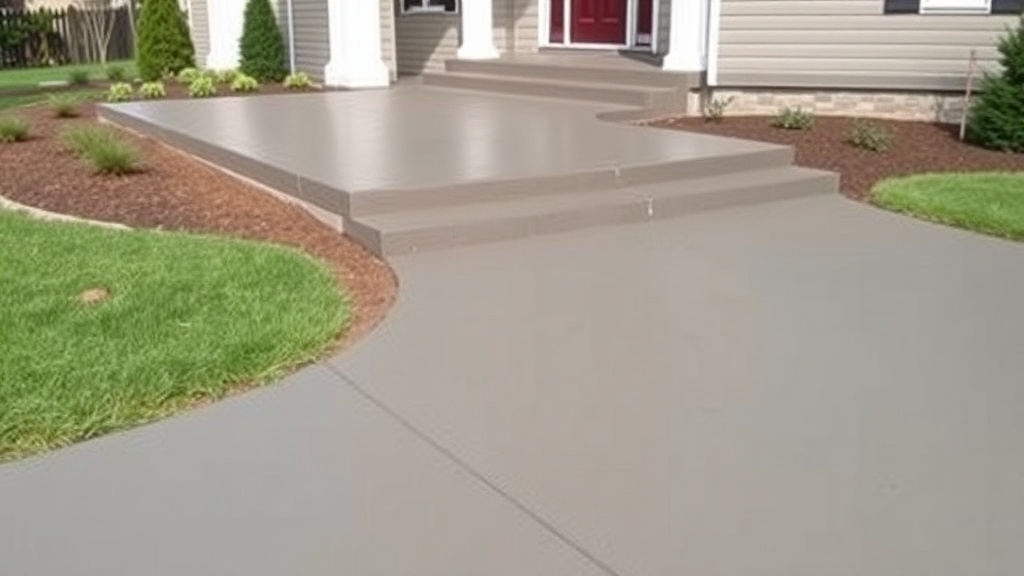
The driveway cured for 48 hours before vehicle traffic. The finished surface is level, smooth, and jointed. The apron transitions cleanly to the street. The homeowner has a correctly specified slab that will resist freeze-thaw scaling and has a defined joint pattern to direct any future shrinkage cracking away from mid-slab random breaks.
Frequently Asked Questions
What makes air-entrained concrete different from standard concrete? During mixing, an air-entraining admixture creates a uniform distribution of microscopic air voids throughout the concrete matrix - roughly 5-7 percent by volume. When water in the concrete freezes, it needs to expand. Air-entrained concrete provides space for that expansion within the matrix itself, which reduces the internal tensile stress that causes surface scaling. In the Chicago area, where driveways experience dozens of freeze-thaw cycles per winter, air entrainment is not optional for a long-lasting slab.
Why do control joints prevent cracking, and how are spacing intervals calculated? Control joints are intentional weak planes tooled into the slab surface at depth. Concrete shrinks as it cures and expands and contracts with temperature. That movement creates stress, and the stress finds the weakest point in the slab to crack. A control joint is the designated weakest point. The standard spacing formula is 2.5 times the slab thickness in feet - on a 4-inch slab, that gives joints every 10 feet. Joints at that interval allow the slab to move predictably at the joint rather than randomly across the field.
How soon can you drive on newly poured concrete? Light vehicle traffic is acceptable after 48 hours in normal curing temperatures above 60 degrees. Full strength - 4,000 PSI - is reached at 28 days. We advise against parking heavy vehicles or equipment on a new residential driveway for the first week and recommend waiting 30 days before applying any sealer, which can trap moisture and interfere with the curing process if applied too early.