
Call Now Free Quote
(847) 713-1648 Get Free Estimate
Concrete Services - Grayslake, IL

Front Walkway and Entry Steps Replacement - 2010 Concrete

August 27, 2025 | Central Grayslake residential area

Before: Front Walkway and Entry Steps Replacement - 2010 Concrete Before
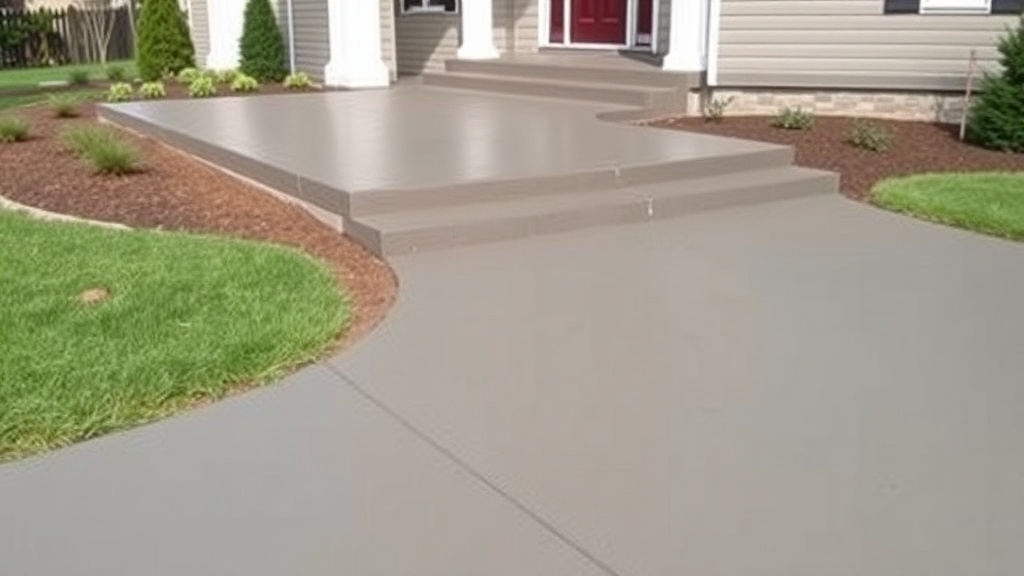
After: Front Walkway and Entry Steps Replacement - 2010 Concrete After
Location Grayslake, IL
Scope Demolition and removal of existing walkway slabs and entry steps. Sub-base regrade and compaction. Pour of new 4,000 PSI air-entrained walkway in three sections with placed control joints. Formed and poured new entry steps with broom finish.
Mortar Type 4,000 PSI air-entrained
Duration 3 days
Building 2010 concrete walkway and steps replacement

The Problem

The owners of a home in Central Grayslake had a front walkway and entry steps poured around 2010 that had deteriorated faster than expected. The walkway had settled unevenly at two points, creating step-down lips between sections that were becoming a trip hazard. Surface scaling had removed the top 1/8 to 3/16 inch of paste from most of the slab, leaving an aggregate-exposed finish that collected water and drove further freeze-thaw damage.

The entry steps were in worse condition. The nose of the top step had broken off cleanly, and deep surface cracks had allowed water into the step body. That water froze and widened the cracks over successive winters. Surface patching was not viable - the internal crack network meant any overlay would delaminate within a season or two.

Voids visible at the slab edge confirmed the sub-base had settled under both sections of walkway.

Our Solution

We demolished the walkway slabs and steps with a small jackhammer and removed all debris. The sub-base was excavated to uniform depth, regraded, and compacted. Soft spots were filled with compacted gravel rather than left for the concrete to bridge.

The new walkway was formed in three sections with control joints placed every 4.5 feet and at the section breaks. The mix was 4,000 PSI air-entrained concrete at a target 6 percent air content, the correct specification for Illinois exterior flatwork. Slump was held without adding water at the truck - a common shortcut that reduces finished slab strength. After floating, the surface received a broom finish and joints were tooled in the plastic state.

The steps were formed with steel-edged forms for clean, consistent riser faces and a 1/8-inch-per-foot tread pitch draining water away from the door threshold. Tread edges were finished with a step tool to produce a slight radius that resists chipping better than a sharp arris.

The Result

The walkway is flat across all three sections with no lips at control joint locations. The steps align squarely with the threshold landing. The broom finish and tread pitch drain water clear at the step faces. Control joints give the slab directed break lines for seasonal movement rather than random mid-slab cracking.
Related: Concrete Services | Grayslake Service Area

Questions About This Project

Why did concrete poured only 15 years ago fail badly enough to need full replacement?

Concrete placed in the 2008 to 2012 range around Lake County frequently ran into two problems: low-slump mixes were sometimes over-watered at the pour to make them workable, which weakens the finished slab, and control joints were often cut too late or spaced too far apart, so the concrete cracked randomly rather than at the intended break lines. Combined with Illinois freeze-thaw cycling, surface scaling accelerates on any slab where the water-cement ratio was too high at placement.

What does air-entrained concrete do that standard concrete does not?

Air entrainment introduces microscopic bubbles into the mix during batching. Those bubbles act as pressure relief valves when water in the slab freezes and expands. Without air entrainment, freeze-thaw pressure has nowhere to go and forces the surface to scale and flake. In Illinois, exterior flatwork in ground contact should always be air-entrained. The air content for a driveway or walkway in our climate is typically 5 to 7 percent of mix volume.

How are control joints placed to prevent random cracking?

Control joints are tooled or saw-cut grooves placed at regular intervals in a fresh or newly hardened slab to create a deliberate weak point where the concrete will crack as it cures and moves. Correctly spaced, they direct all cracking to the joint location rather than across the slab face. For a residential walkway, we typically place control joints every 4 to 5 feet, or at a spacing equal to 1.5 times the slab width, whichever is smaller. Joints that are too widely spaced leave spans of concrete with no directed break line.

Project Location

Loading map - 1 project in this area

Need Similar Work? Let's Fix It Right.

Free on-site inspection and written estimate - no obligation. Serving the North Shore and Chicagoland for over 39 years.

(847) 713-1648 Request Online Estimate