The Problem
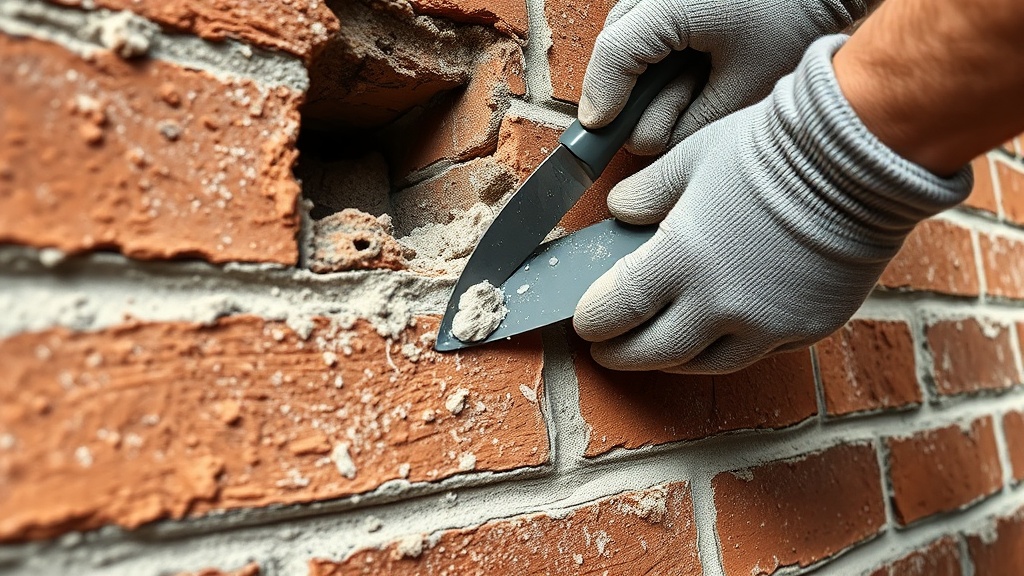
A real estate attorney who had recently inherited a family home in East Highland Park contacted us after noticing a diagonal step crack running from a first-floor window corner down to the foundation course on the north facade. The home is a 1911 Arts and Crafts building with original clinker brick throughout, a material that is no longer commercially produced.
The crack was a stair-step pattern tracking the mortar joints over nine courses, a typical profile for differential settlement. The homeowner confirmed the crack had been photographed and measured annually for four years with no measurable change in width, suggesting the settlement was complete. The widest point at the window sill measured 3/8 inch.
Beyond the crack, the full north and west facades showed mortar recession averaging 1/2 inch across all joints, with several areas near downspout discharge points showing active moisture staining and soft mortar that crumbled on probe. The original mortar was a pure lime putty and sand mix with no Portland content.
Twelve clinker brick units in and around the crack path had fractured. Clinker units are dense and vitrified, but the crack had propagated through several faces rather than tracking the joint, indicating the units had been under tension.
Our Solution
We sourced 12 replacement clinker brick units from a Waukegan salvage yard that recovers material from pre-war North Shore demolitions. The replacements were matched by density (tap test and visual inspection), face texture, and dominant color tone. We could not achieve an exact color match, so we positioned the least-matching units in the lower two courses where they are least visible from grade.
The restoration mortar was NHL 3.5 mixed at a 1:2.5 ratio by volume (one part NHL 3.5 powder to 2.5 parts washed fine-grain natural sand). We did not use Portland in any quantity on this home. NHL 3.5 sets more slowly than Portland-based mortars, requiring extended curing time but producing a mortar chemistry that is compatible with the original lime putty joints and will not lock in a rigid shell over the soft brick.
Joint preparation throughout used a 3-inch oscillating grout saw rather than a rotary grinder to minimize vibration stress on the clinker units. Depth was held to 5/8 inch, verified with a depth gauge every sixth course. The step crack cavity was packed in three lifts due to its depth, with 24-hour intervals between lifts to allow partial carbonation before the next layer was applied.
All joints were tooled with a flat slicker to replicate the flush-cut profile original to the Arts and Crafts period.
The Result
The 14-day project produced a fully repointed north and west facade with the step crack filled and the 12 replacement clinker units set. The NHL 3.5 mortar will continue to harden through carbonation over the next 12 to 18 months.
The homeowner has a written mortar specification and sourcing notes for the salvage yard used, giving any future contractor a baseline for continuing the restoration work to the same standard.