
The Problem
The current owners of this 1912 Colonial Revival in Central Winnetka near Green Bay Road inherited the home from a parent. The home had been in the family for four decades, and maintenance over that period had been selective - interior updates and mechanical systems, but the masonry facade had received no professional attention. The owners knew the building needed work before they had their first look with us.
What a multi-generational home without masonry maintenance looks like after 40 years of Chicagoland freeze-thaw cycles is fairly predictable: progressive mortar recession across the most exposed elevations, some moisture-related brick damage in corners and base courses, and localized structural concerns where water intrusion had reached wood framing or masonry support elements.
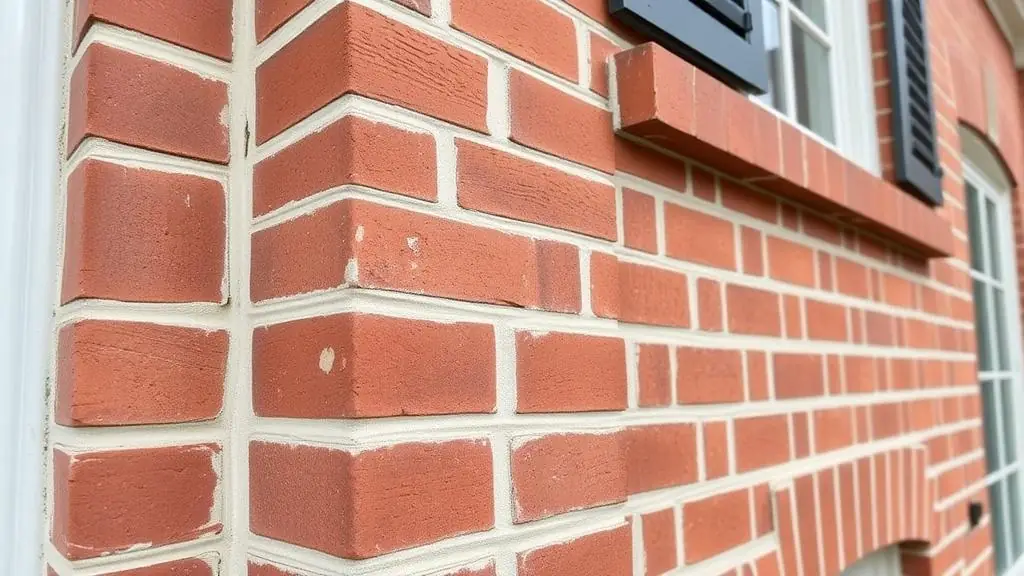
On this home, the north and east elevations showed mortar recession averaging 7/8 inch, with several locations reaching 1-1/4 inches. The portico pilaster bases on the front elevation had lost mortar through to a depth that had allowed water to freeze behind the base course and work the pilaster units out of plumb by approximately 1/2 inch. The Flemish bond coursing on the east gable had been disturbed by prior patching - several courses had been filled with stretcher-only brick in a pattern that did not match the original.
Our Solution
We began with mortar extraction from three protected joint locations - the south porch interior, an underside joint at the cornice return, and a basement window jamb. Lab analysis of the extracted samples confirmed a natural lime formulation with trace hydraulic components and a low Portland content. NHL 3.5 was selected to replicate that original chemistry as closely as a commercially available modern product allows.
On the north and east elevations, we removed all recessed mortar to a clean substrate. In locations where recession exceeded one inch, we hand-chiseled rather than ground to avoid vibration stress on already-fatigued joints. All joints were packed in three lifts in those deep locations - first to half depth, allowed to firm, second to 3/4 depth, allowed to firm, then the finish lift tooled to a slightly weathered beaded profile matching the original south elevation joints.
The portico pilaster bases required full disassembly: we removed the out-of-plumb courses, cleaned the base units, and reset each unit in fresh NHL 3.5 mortar with a plumb tolerance of 1/8 inch per four feet. Temporary bracing held the reassembled pilasters through a 72-hour cure.
The disturbed Flemish bond on the east gable was rebuilt using salvage brick matched to the original header face dimensions. Six courses were relaid in correct alternating pattern.
The Result
At the completion of three weeks, the full facade restoration brought all four elevations to a consistent, documented condition for the first time in the owners’ knowledge of the home. The portico pilasters are plumb. The Flemish bond on the east gable reads correctly. Mortar color across new and original joints is within a natural weathering range.
We provided the owners with a restoration record including core analysis results, the NHL 3.5 mix specification used, and a photographic survey of each elevation before and after. The home is now properly documented for any future masonry work.