
Call Now Free Quote
(847) 713-1648 Get Free Estimate
Tuckpointing - Norridge, IL

Tuckpointing - 1952 Brick Bungalow with Limestone Sill Course

November 2, 2025 | near Cumberland Avenue

Before: Tuckpointing - 1952 Brick Bungalow with Limestone Sill Course Before
After: Tuckpointing - 1952 Brick Bungalow with Limestone Sill Course After
Location Norridge, IL
Service Tuckpointing
Scope Full facade, 4 elevations, limestone sill course repointed
Mortar Type Type N
Duration 4 days
Building 1952 brick bungalow with limestone sill course

The Problem

The owner of a 1952 brick bungalow on a Central Norridge residential block noticed mortar crumbling along the front and side facades. Joints on the north elevation were the worst - recessed nearly a half inch in places and showing surface cracking across most of the wall. Several joints near the limestone window sills had failed completely, and water staining on the limestone surface suggested moisture was working its way into the sill seat.

The limestone sill course was original to the home. The mortar at the limestone-to-brick interface had failed along both front windows, creating a gap wide enough for water to pool against the sill base. That water, once inside the sill seat, was a direct path into the window rough opening above.

Our Solution

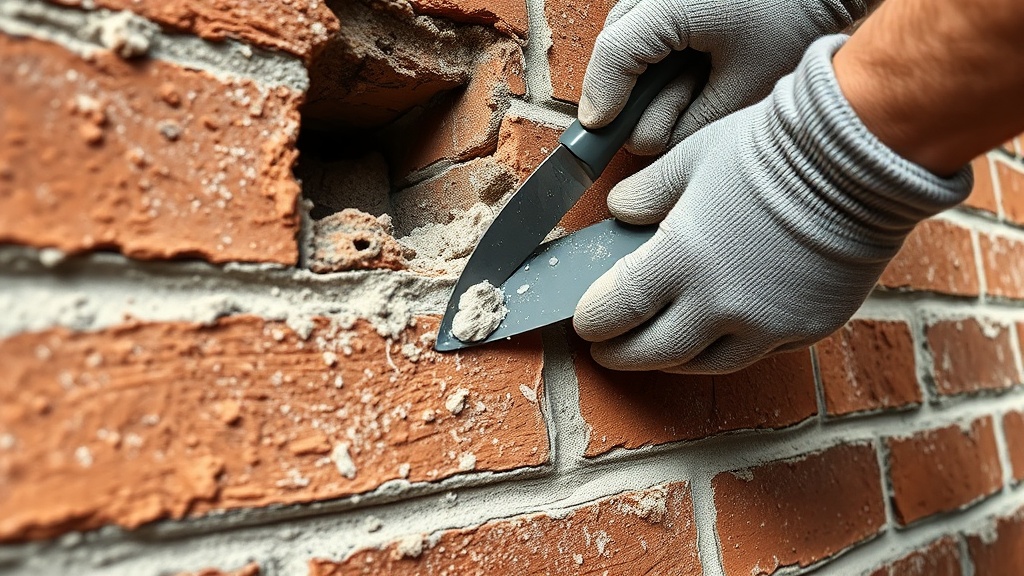
We removed deteriorated mortar to a uniform depth of 3/4 inch across all four elevations using angle grinders fitted with diamond blades set to a controlled cutting depth. At the limestone sills, we used a narrow oscillating tool along the sill interface rather than a grinder to avoid scoring the stone face.

The replacement mortar was Type N - the correct specification for this era and brick type. We pulled mortar color samples from a protected joint on the interior chimney stack, which had not been exposed to weathering. The final sand selection matched the original warm gray tone closely.

All joints were packed in two lifts per joint, with a firm-up period between lifts. At the limestone sill interface specifically, the joint was tooled with a recessed wash profile rather than the standard concave tool used on the field joints - this profile encourages water to shed forward off the sill nose rather than sitting against the limestone-to-brick interface.

The Result

All four elevations were completed in four days. The limestone sill joints are sealed and profiled for drainage. The mortar color is consistent with the original joints visible in protected areas under the front porch soffit.

The homeowner now has a complete mortar record for the home, including the sand color and Type N blend used, so any future spot repairs can be matched.
Related: Tuckpointing Services | Norridge Service Area

Questions About This Project

Why does the joint between limestone sills and brick require special attention during tuckpointing?

Limestone and brick expand and contract at slightly different rates as temperature changes. The interface joint between them is a natural movement plane that collects water and debris. When mortar at that joint fails, water gets under the sill and into the sill seat - the ledge of masonry the sill rests on. Once water enters the sill seat, freeze-thaw cycles work upward into the window head above. We tool that joint with a slightly recessed profile to encourage drainage forward off the sill rather than sitting against the interface.

What does tuckpointing on a 1950s bungalow typically involve?

On most 1950s bungalows in the northwest Cook County suburbs, the original mortar is a lime and sand mix with moderate Portland content - roughly equivalent to today's Type N. After 70 years, those joints are typically recessed 1/4 to 1/2 inch and show surface crumbling. Full facade tuckpointing on a standard bungalow means removing deteriorated mortar to 3/4 inch depth on all four elevations, then packing with matched Type N mortar in two lifts and tooling to the original profile.

How long does tuckpointing take on a single-story bungalow?

On a standard 1950s single-story brick bungalow with a full basement, we typically complete all four elevations in 3 to 5 days depending on total linear footage of joints and the condition of the original mortar. Harder original mortar means slower removal to avoid damaging brick. Softer or heavily deteriorated mortar speeds the process. We do not split jobs over multiple weeks - we work through to completion to keep the open joints from taking on water during the project.

Project Location

Loading map - 1 project in this area

Need Similar Work? Let's Fix It Right.

Free on-site inspection and written estimate - no obligation. Serving the North Shore and Chicagoland for over 39 years.

(847) 713-1648 Request Online Estimate