The Problem
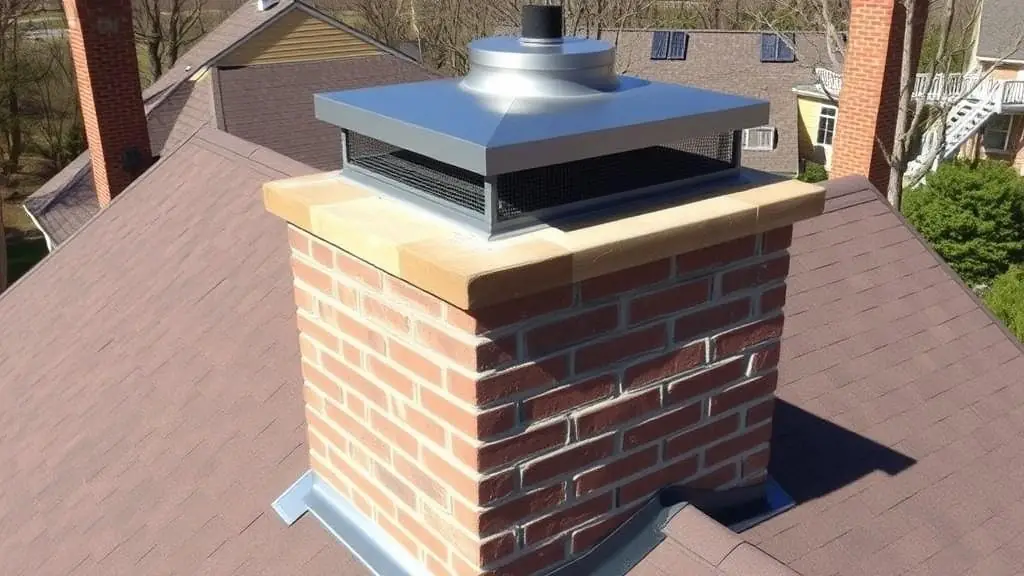
Cumulative freeze-thaw deterioration on this 1894 Late Victorian chimney mass had been progressing quietly for years. The homeowners in the Lakeshore Historic District noticed the problem when mortar fragments began appearing in the gutters each spring. On inspection, the three-flue chimney showed recessed joints averaging 5/8 inch deep on the exposed north and east faces, with two corbel courses showing displaced brick where the mortar had failed to the point that the masonry above was no longer fully supported. The chimney cap, a poured concrete replacement from an unknown earlier repair, had cracked across its full width and was admitting water directly into the flue space. The lower portion of the chimney, sheltered by roof overhang on the south side, remained in reasonable condition. The upper two stories of the mass required complete repointing.
Our Solution
We built a tube scaffold inside the chimney access on the roof to reach the upper courses safely without damaging the standing-seam metal roof. All loose and recessed mortar was raked to 3/4-inch depth using hand tools rather than power equipment. On Victorian-era soft brick, rotary grinding consistently results in beveled brick edges that alter the joint profile permanently.
The mortar we used was a Rosendale-style blend: natural cement, lime putty, and clean sharp sand proportioned to produce a compressive strength in the 600-800 psi range, well below the brick strength and consistent with the original 1894 formulation. Sand aggregate was selected for size and color to match the protected joint samples we pulled from the interior flue faces. All joints were packed in two lifts and finished with a shallow concave profile matching the original tooling.
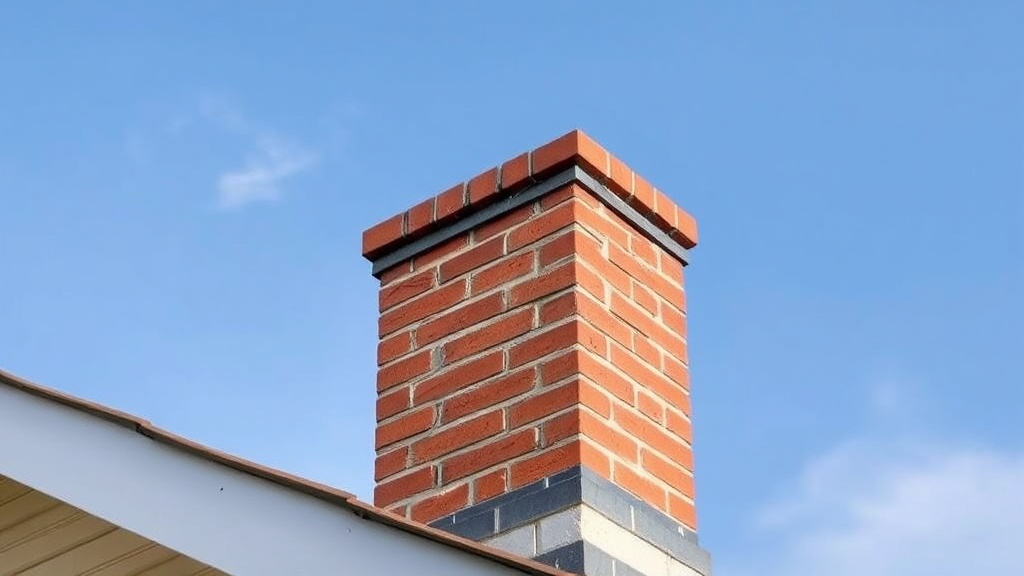
The two displaced corbel courses were disassembled, mortared, and reset with temporary shoring in place. The corbel configuration on this chimney is a double-step brick projection typical of Late Victorian decorative chimney design in the Lakeshore district, and the reset brick courses align within 1/16 inch of the original plane. The new crown was poured with a fiber-reinforced mix and sealed with an elastomeric coat.
The Result
The full three-flue mass is repointed and weathertight. Corbel courses are reset and stable. The new crown sheds water away from all three flue openings. Mortar formula, joint profile dimensions, and photographic documentation were provided to the homeowners for their Historic District compliance file. No further fragment loss had been reported as of the following spring inspection.