The Problem
The owners of this 1898 Late Victorian in East Wilmette near Lake Avenue had maintained a regular inspection schedule with us, having had the facade assessed every five years. The previous inspection five years prior had noted 1/2 inch average mortar recession on the north and east elevations and recommended monitoring but not immediate repair.
When we returned for the current inspection cycle, the condition had progressed beyond the monitoring threshold. Average recession on the north elevation had reached 1-1/8 inch, and the east elevation showed 7/8 inch average with two locations where open voids had formed at joint intersections. The south elevation remained at approximately 3/8 inch recession and did not require attention.
The bay window surround - a defining character feature on this Late Victorian facade - had developed face spalling on three brick units where water had tracked behind the decorative header course and frozen. The bay window construction on homes of this era uses projecting courses that collect and hold water against the upper brick face, and those locations require more frequent attention than flat wall sections.
The lesson from this inspection cycle was consistent with what we have seen on other pre-1900 homes: mortar deterioration accelerates once recession passes the 1/2 inch mark. The recommendation from the prior cycle to monitor rather than repair was a reasonable judgment at the time, but the progression here was faster than the five-year interval allowed for.
Our Solution
We began with mortar core extraction from three locations: a protected interior joint at the rear addition junction, a basement window jamb sheltered from weathering, and a sheltered porch soffit joint. The extracted samples were analyzed and confirmed a natural hydraulic lime composition with no detectable Portland content - consistent with construction before Portland cement became standard in residential masonry.
Our Rosendale-style blend uses a natural hydraulic lime as the binding agent with natural sand aggregate proportioned to approximate the original mortar’s compressive strength range of 200-400 psi at 28 days. This keeps the new mortar in the correct relationship with the soft Victorian common brick - weaker than the brick unit, so the joint remains the sacrificial element in freeze-thaw cycling.
On the north and east elevations, we removed all recessed mortar by hand chisel throughout. At 1-1/8 inch average recession, mechanical grinding was not appropriate - the joint cavities were too deep and the risk of chip-out on the soft brick edges too high. All joints were cleaned with natural bristle brushes and compressed air before packing.
We packed joints in three lifts at the deepest locations, allowing each lift to stiffen to a firm but not hard state before the next. Final tooling used a flat jointing tool to restore the flush-cut Victorian profile, with each joint finished level to the brick face within 1/16 inch.
The three spalled units at the bay window surround were consolidated: spalled faces were removed, the void behind each face cleaned, and the brick unit stabilized with a lime-based hydraulic grout injection before the joint field work was completed around them.
The Result
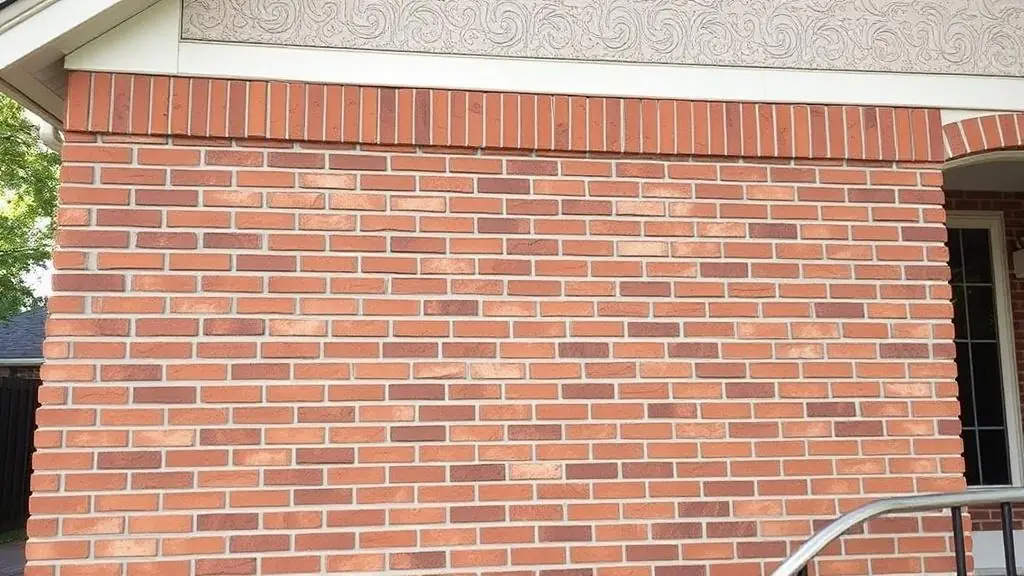
Three weeks of work restored the north and east elevations to sound condition. The flush-cut joint profile now reads consistently across the repaired area, matching the protected south elevation joints that had not required attention.
The bay window surround spalling was arrested. The three affected units are stabilized with their original faces intact, visible as a slight color variation from the adjacent field brick but structurally sound.
We updated the inspection record and recommended the next assessment at three years rather than five, given the rate of progression observed in this cycle.