The Problem
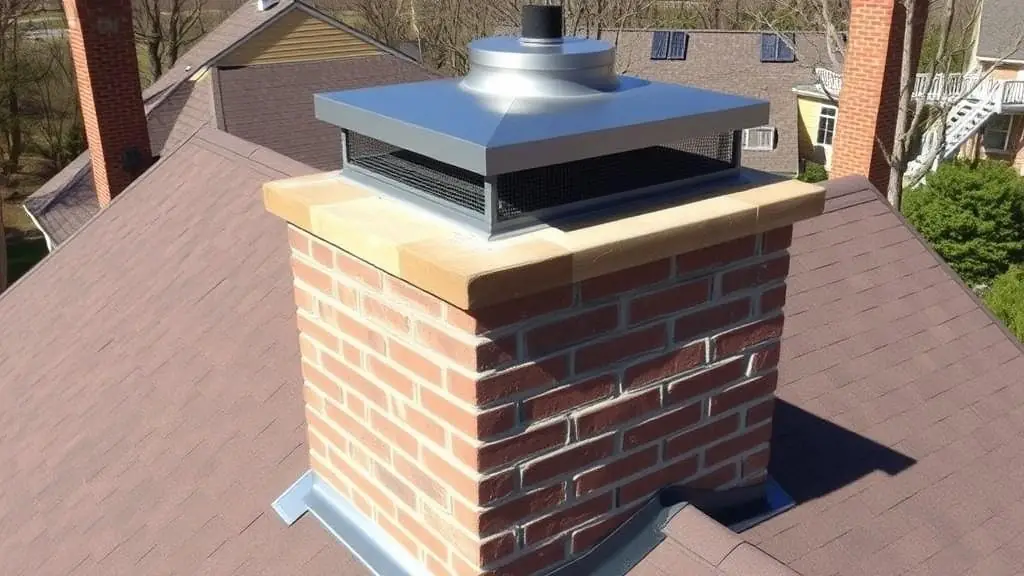
A late-April wind and ice storm knocked loose the corbeled cap on a 1922 Tudor chimney in East Lake Bluff. The homeowner contacted us after noticing a section of brick on the ground in the back yard. When we inspected, the entire corbeled course had separated from the stack and two additional courses of the upper stack had open joints wide enough to pass a 3/8-inch probe.
The chimney serves a wood-burning fireplace in the main living room. Water entry at the open joints had already reached the flue liner, visible as efflorescence on the interior liner tiles 18 inches below the crown. The lead flashing at the chimney-to-roof junction was also pulled loose on the uphill side, a secondary failure from the same storm event.
The original brick is a soft handmade unit typical of 1920s Tudor construction in Lake County. The existing mortar in the undamaged sections of the stack was a cream-colored lime-rich mix, consistent with pre-war formulation.
Our Solution
We accessed the chimney by staging a ladder off the roof slope with a ridge hook anchor. All loose and cracked units from the corbeled cap section were removed by hand to expose clean, sound bed joints below. Eight brick units in the corbeled course were cracked through and replaced; the remaining corbel units were sound and reset in place.
The replacement mortar was mixed as a Type N lime-blend: one part Portland, 1.5 parts masonry lime, and five parts natural sand. We matched the original sand aggregate by pulling a protected mortar sample from the interior flue access and comparing grain size and color under magnification. The lime content was increased slightly beyond standard Type N to improve workability in the tight corbel joints, which measure 3/8 inch on the original profile.
Upper stack repointing ran down four courses from the cap to sound mortar. Joint grinding used a 4-inch grinder with a 3/16-inch blade, stopping at 3/4 inch depth. All joints were tooled with a convex jointer to match the rounded original profile.
The lead flashing was re-dressed and sealed at the step and counter-flashing seams with a lead-appropriate sealant rated for roofline thermal movement.
The Result
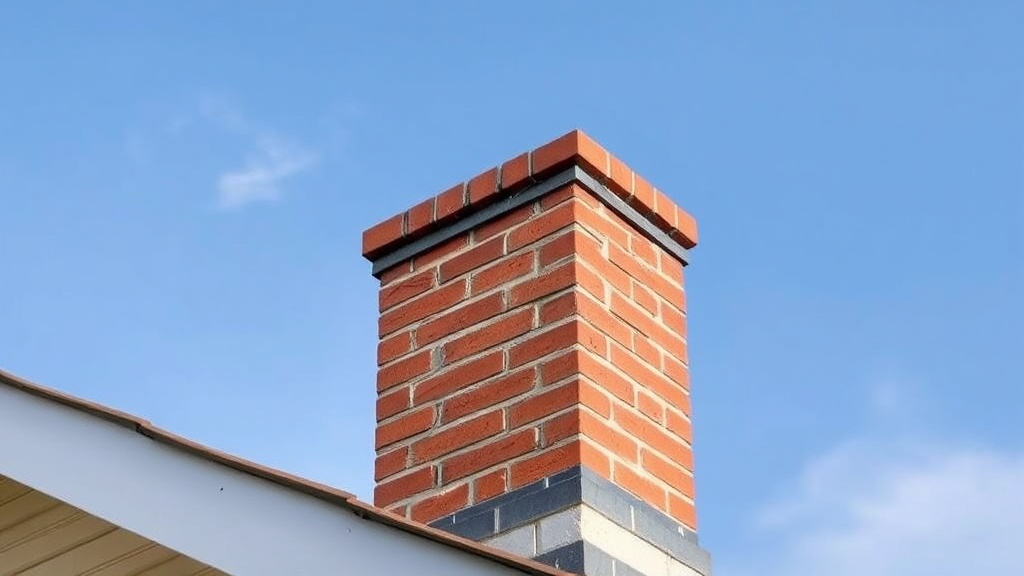
The corbeled cap was rebuilt to match the original four-course profile, including the overhang dimension of 1.5 inches per course. The mortar color matches the existing undisturbed joints on the lower stack.
The flashing is seated and sealed. Interior efflorescence in the flue liner will clear through normal evaporation over one to two heating seasons as the stack dries.
We documented the rebuilt cap profile and mortar formula for the homeowner’s maintenance file.