
The Problem
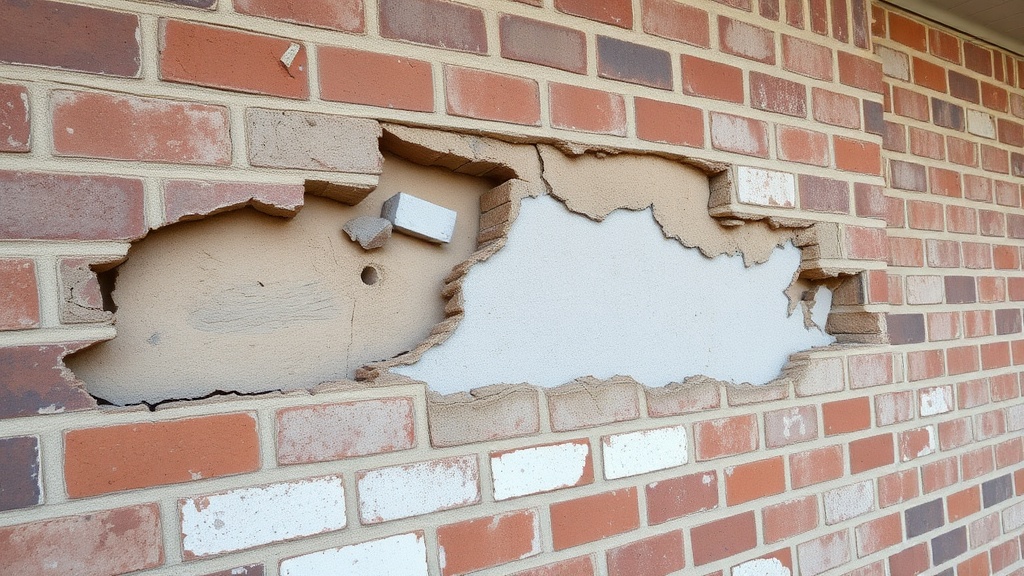
A home inspector flagged mortar joint deterioration and spalling brick on the front and south-facing side facades of a 1968 brick Colonial in West Lake Bluff. The owners were preparing to list the property and needed the work completed before photography and open house.
The inspection report identified 34 brick units with face spalling ranging from surface crazing to full-depth fractures. Several units near the front entry had lost more than 40 percent of their face. Open mortar joints were present along two window sill courses and at the base of the front porch column returns. The column return joints measured 5/8 inch deep with no residual bond to either brick surface.
The inspector also noted a prior patch on the east-facing garage wall using a grey Portland cement mix that did not match the original joint profile. That patch was contributing to moisture retention against the adjacent brick, accelerating the spalling on that section.
Our Solution
We began with a full facade survey to identify every compromised unit and every open joint, not only the ones the inspector had flagged. The final count was 34 replacement units and approximately 90 linear feet of repointing across both facades.
Damaged brick was removed with a hand chisel and rotary hammer set to low impact to avoid disturbing the courses above. Each cavity was cleaned, dampened, and back-buttered before the replacement unit was set. We used a Type N mortar at a 1:1:6 ratio (one part Portland, one part masonry lime, six parts sand) with a fine-grain buff sand to approximate the original joint tone.
Joint grinding for the repointing ran at 3/4 inch depth using a 4-inch angle grinder with a 1/8-inch diamond blade. The blade depth stop was set before the first pass and checked every third course to maintain consistency. The mismatched Portland patch on the garage wall was ground out and replaced with the same Type N blend used on the primary facades.
All repointed joints were tooled with a sled jointer to match the original struck profile throughout the home.
The Result
Work was completed in three days, two days ahead of the scheduled listing photography. All 34 replacement units were set and pointed. The mortar color on the new joints matches the original within a tone across all repaired sections.
The Portland patch on the garage wall was fully removed and replaced. The inspector signed off on the completed scope before the listing went live.
We recorded the mortar batch and brick unit sourcing for the buyers’ file.