The Problem
The homeowner called to schedule a general chimney inspection - not because they had noticed any specific problem, but because they had moved into the home two years prior and had no record of when the chimney had last been looked at. This is exactly the scenario where a routine inspection earns its cost.
From the ground, the chimney appeared in reasonable condition. Minor surface staining on the upper courses was the only visible indicator of anything worth examining. From the roof, the picture changed considerably. The chimney crown had a through-crack running its full width - left to right, across the widest dimension - wide enough to slide a business card into. The crown had also lost its proper overhang profile on the south side, where it had settled slightly and no longer provided a drip edge.
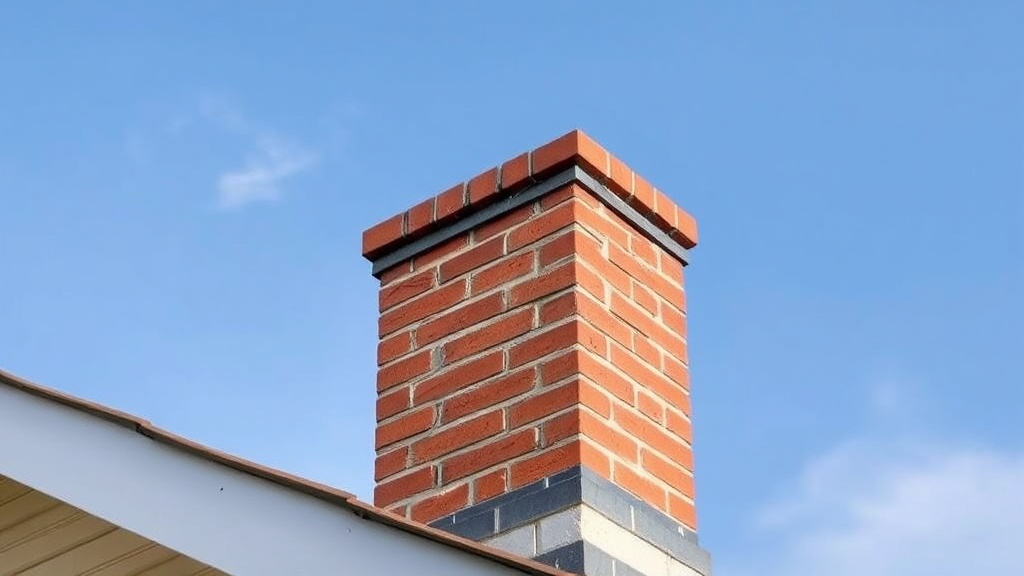
Mortar joints on the north and west faces of the upper two courses above the roofline showed recession averaging 7/8 inch. The south and east faces were better - 1/2 inch average - but still beyond the threshold where repointing should have been done. The home was built in 1972 with a prefabricated firebox serving the living room; the brick chimney enclosure showed no previous repointing, meaning the original mortar was now over 50 years old at the surface.
The steel liner was intact and showed no corrosion on visual inspection. The brick body of the chimney below the roofline was in solid condition.
Our Solution
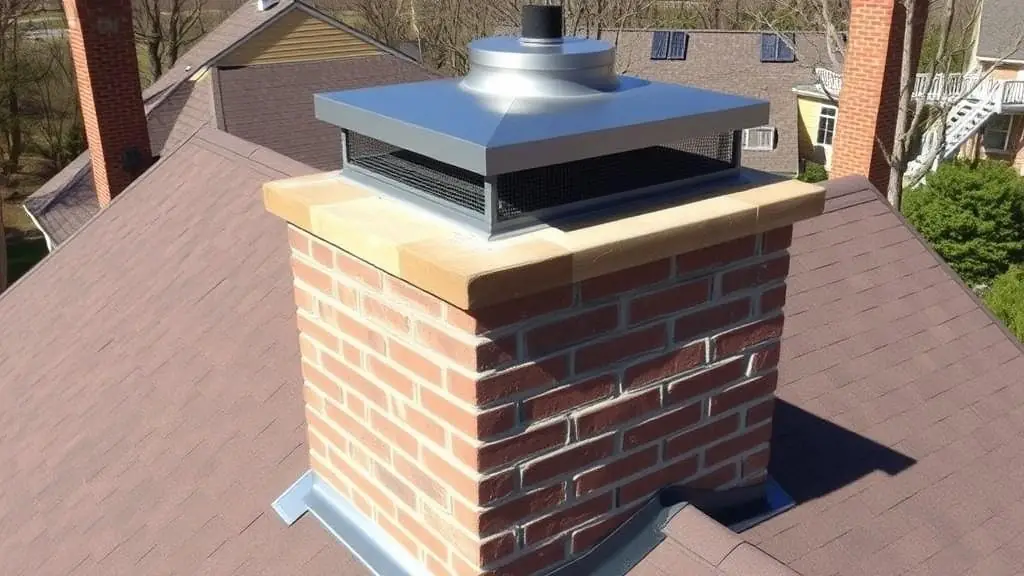
We demolished the existing crown completely, removing all material to the top brick course. The new crown was formed with perimeter wood forms to create a 2-inch overhang on all four sides with a properly sloped drip edge. We used a fiber-reinforced concrete mix rated for exterior freeze-thaw exposure, poured in one continuous pour and finished with a 1/4 inch per foot slope away from the steel liner collar.
All four chimney faces were repointed with Type N mortar after grinding joints to 3/4 inch depth with a 4-inch grinder and 1/8-inch diamond blade. On the north and west upper courses where recession exceeded 3/4 inch, we ground to full depth and cleared the cavity with compressed air. Mortar was mixed at a 1:1:6 portland-lime-sand ratio appropriate for late-period residential chimney construction. All joints were packed in two lifts, with the second lift tooled to a concave profile using a 5/8-inch jointer.
A new stainless steel chimney cap sized to the steel liner diameter was installed over the flue. The cap includes a 5/8-inch mesh screen on all four sides.
The Result
The rebuilt crown, repointed joints, and new cap address every water entry point that had been developing on this chimney. The homeowner now has a documented baseline - repair date, materials used, and scope completed - for future maintenance scheduling.
The inspection that prompted the call cost less than the repair that followed. The repair cost considerably less than the water damage the open crown would have eventually caused to the chimney interior and the living room ceiling below.