
Call Now Free Quote
(847) 713-1648 Get Free Estimate
Brick Repair - Grayslake, IL

Brick Tie Failure and Bulging Wall Repair - 2003 Brick Estate

November 3, 2025 | Saddlebrook neighborhood

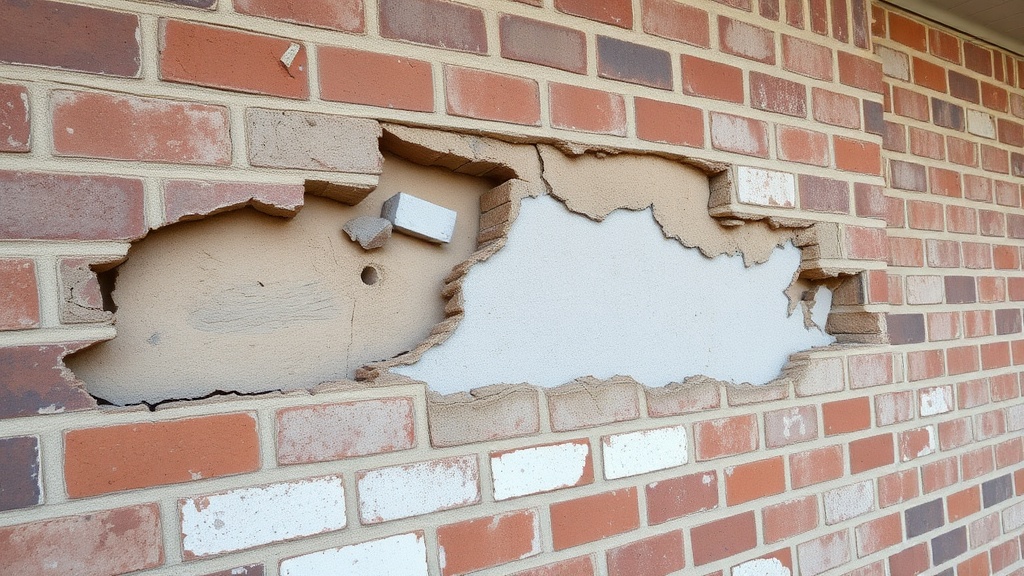
Before: Brick Tie Failure and Bulging Wall Repair - 2003 Brick Estate Before
After: Brick Tie Failure and Bulging Wall Repair - 2003 Brick Estate After
Location Grayslake, IL
Service Brick Repair
Scope Removal and reset of bulging veneer section on garage front elevation. Corroded tie replacement with stainless helical ties. Full repointing of reset section and adjacent courses. Weep hole clearing on full front elevation.
Mortar Type Type N
Duration 5 days
Building 2003 brick estate home

The Problem

The owners of a 2003 brick estate home in Saddlebrook noticed the garage front elevation bowing outward. Sighting along the wall face showed a bow of roughly 1/2 to 3/4 inch across an 8-foot run centered on the left bay. At the base of the affected section, several head joints had opened slightly.

The cause was tie failure. Probing from inside the garage confirmed corroded galvanized wire ties in the affected zone that had lost their mechanical connection to the stud framing. With no restraint, thermal expansion had pushed the veneer outward.

Compounding the problem, every weep hole along the front elevation was blocked with mortar droppings from the original 2003 pour. No water could exit the cavity, which accelerated the tie corrosion from inside.

Our Solution

We dismantled the bulging section brick by brick, numbering courses and preserving each unit for reinstallation. The specific texture and color of 2003 Saddlebrook estate brick would be difficult to match with new production, so recovering the originals was the priority.

The corroded galvanized wire ties were removed and replaced with stainless steel helical screw ties mechanically fastened to studs at correct spacing. Stainless ties resist cavity moisture that destroys galvanized wire, and the helical profile provides better pull-out resistance than a straight hook.

Original bricks were reset in order using Type N mortar with full bed and head joint coverage. Each course was checked for plumb before the next was set. After initial set, we repointed the reset zone plus two adjacent courses on each side to create a consistent transition. Along the full front elevation, we cleared every blocked weep hole with a narrow pick tool and wire brush, confirming each location was open to the cavity before finishing.

The Result

The front elevation reads flat across both garage bays. The reset section aligns with the surrounding veneer and joints match in color and profile. Weep holes are clear along the full front elevation. The homeowners have written documentation of the tie replacement type and location.

Related: Brick Repair Services | Grayslake Service Area

Questions About This Project

What causes brick veneer to bulge outward on a newer home that is only about 20 years old?

Bulging on brick veneer homes from the early 2000s is almost always caused by corroded or improperly installed metal ties that anchor the veneer wythe to the sheathing behind it. When those ties fail, the brick veneer is no longer restrained and thermal expansion causes it to bow outward. In some cases the ties were undersized for the span, set in mortar beds rather than mechanically fastened to studs, or galvanized rather than stainless and subject to early corrosion in damp wall cavities.

Can bulging brick veneer be pushed back without removing it?

Rarely, and not reliably. In most cases the bulging section must be carefully dismantled, the failed ties removed, and new mechanical ties installed before resetting the brick. Attempting to force a bulged section back without removing the brick risks cracking the brick, breaking whatever tie engagement remains, and creating a worse structural condition. The correct repair is disassembly and systematic re-anchoring.

What are weep holes and why do they matter on brick veneer construction?

Weep holes are small openings left at the base of a veneer wall, typically every third or fourth head joint in the first course above grade, that allow any water that enters the cavity behind the veneer to drain out rather than accumulate. Blocked weep holes trap moisture in the cavity, which accelerates tie corrosion and can cause efflorescence and spalling. On homes 20 years or older, weep holes are frequently plugged with mortar droppings, insect nests, or debris and need to be cleared as part of any brick work at the base of the wall.

Project Location

Loading map - 1 project in this area

Need Similar Work? Let's Fix It Right.

Free on-site inspection and written estimate - no obligation. Serving the North Shore and Chicagoland for over 39 years.

(847) 713-1648 Request Online Estimate