The Problem
The homeowner had inherited the 1958 split-level from a parent who had lived there from original purchase through the mid-2000s, after which the home sat largely unoccupied or used only seasonally for several years before the current owner moved in. A family ownership transfer had meant that routine maintenance decisions - including tuckpointing - had been passed over for close to two decades.
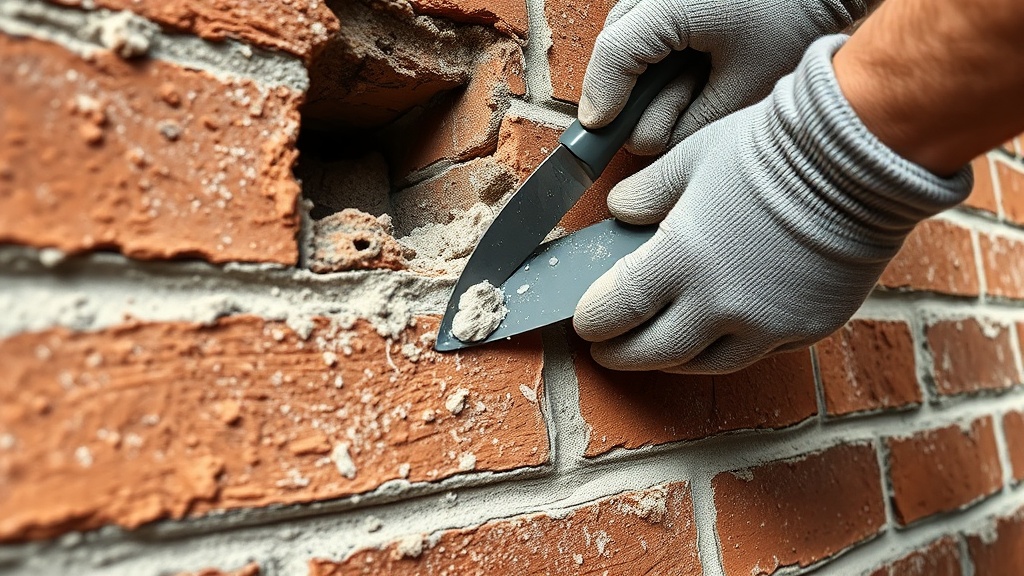
The condition reflected that timeline. On the north and west elevations, mortar recession averaged 7/8 inch, with multiple locations exceeding one inch. In those deepest joints, we could see that mortar bond to the brick face had been lost, leaving a soft, granular column of material that compressed under finger pressure. The front elevation was in better shape cosmetically, but only because a previous occupant had patched sections of the lower three courses with a tube-applied mortar repair product. That patch material had already debonded along its edges and was sitting in the joint without meaningful adhesion.
The south and east faces showed more moderate deterioration - averaging 5/8 inch recession - consistent with less direct weather exposure. The brick units throughout the building were structurally intact, with no spalling or through-cracking. The masonry assembly itself was solid. Only the mortar needed attention.
Our Solution
We began by removing the DIY patch material from the lower front elevation. The tube-applied product had no mechanical bond to the brick face and came out with a cold chisel and moderate hand pressure. Beneath it, the original joints were recessed 1/2 inch - less severe than the side elevations, explaining why a patch had seemed workable to a non-professional.
Across all four elevations, joints were cut to 3/4 inch minimum depth using 4-inch angle grinders with 1/8-inch diamond blades. On the north and west faces where recession already exceeded 3/4 inch, we cut to the full existing depth - some joints required removal to 1 inch. Those cavities were air-cleaned and dampened before packing to maximize mortar adhesion to the aged brick face.
The replacement mortar was Type N at a 1:1:6 portland-lime-sand ratio. Sand color was matched against core samples extracted from the most protected joint locations: the sheltered porch return and the undersides of window sills on the east face. Joints exceeding 3/4 inch depth were packed in three lifts rather than two, with each lift allowed to reach thumbprint hardness before the next was applied. Final tooling used a 1/2-inch concave jointer matching the original profile retained in the protected porch joints.
The Result
The completed work brought all four elevations to consistent condition for the first time in at least two decades. The front elevation no longer shows the debonded patch seam that had been visible along the lower courses.
The homeowner noted that the north wall, which had shown the most severe deterioration, looked visually transformed - primarily because the recessed joint shadows that had made the wall appear dark and aged were gone.