The Problem
The homeowner’s insurance adjuster had visited following a hail claim and noted damaged brick on the west and south elevations of the 1962 ranch. The adjuster’s report identified visible brick face damage but did not specify count or scope - leaving the homeowner to find a contractor who could assess the repair need and provide documentation.
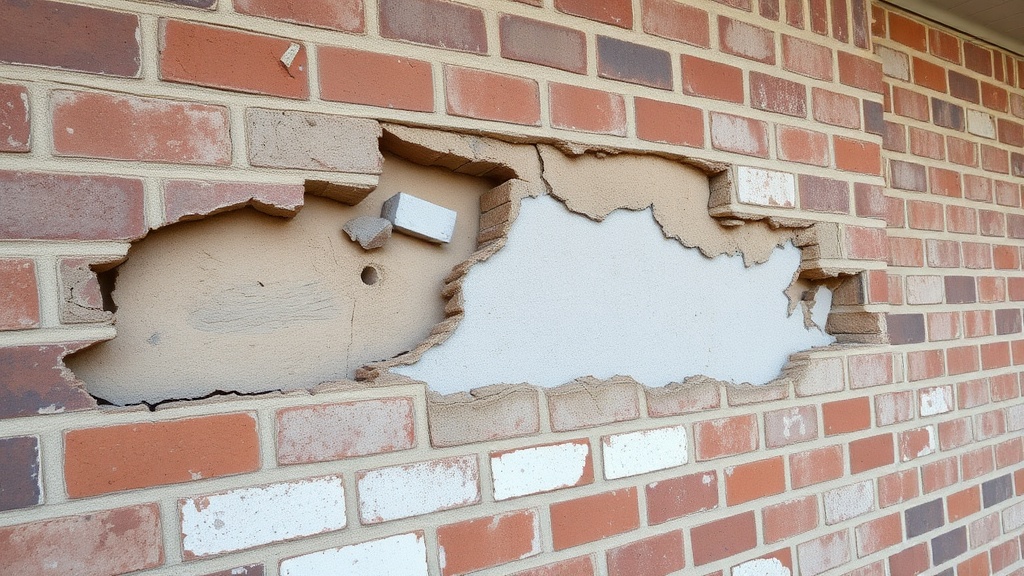
When we walked the property, we found 11 bricks with clear hail impact damage: circular spall craters ranging from 1 to 3 inches in diameter, with sharp-edged fractures and fresh-looking interior surfaces consistent with impact rather than freeze-thaw deterioration. All 11 damaged units were on the west and south elevations, which faced the storm’s direction of travel. The north and east elevations had no comparable damage.
Beyond the impact damage, the surrounding mortar joints on the affected elevations showed 1/2 inch average recession - a pre-existing condition unrelated to the storm but relevant to the scope of repair. Replacing 11 bricks in isolation while leaving deteriorated surrounding joints would result in a visible patch that aged differently from the rest of the wall. We documented both the storm damage and the pre-existing mortar condition separately in our written assessment.
Our Solution
We sourced replacement brick from a supplier carrying discontinued 1960s modular ranch brick. The 1962 vintage uses a specific low-absorption brick with a smooth wire-cut face in a muted reddish-tan tone. We compared three candidate lots under afternoon light on-site before selecting the closest match in color, face texture, and nominal dimensions.
Each damaged brick was removed using hand chisels and a cold chisel, working one unit at a time to avoid disturbing adjacent bricks. Cavity edges were cleaned and wire-brushed. Replacement bricks were back-buttered on three sides and set in Type N mortar with full bed and head joint contact. Joint spacing was held to 3/8 inch to match existing coursing.
After the replacements cured for 48 hours, we repointed all surrounding joints on the west and south elevations to 3/4 inch depth using the same Type N mortar. Joints were tooled to a concave profile matching the undisturbed east and north elevations.
We prepared a written repair summary including per-unit documentation of each impact location, photograph references, and mortar specification for submission to the homeowner’s insurance file.
The Result
The 11 replacement bricks integrate with the surrounding wall without a visible seam. The repointed joints on the affected elevations match the condition of the undamaged faces.
The homeowner submitted our documentation to their adjuster and received reimbursement for the storm-related portion of the repair. The pre-existing mortar work was handled separately as a maintenance item.