The Problem
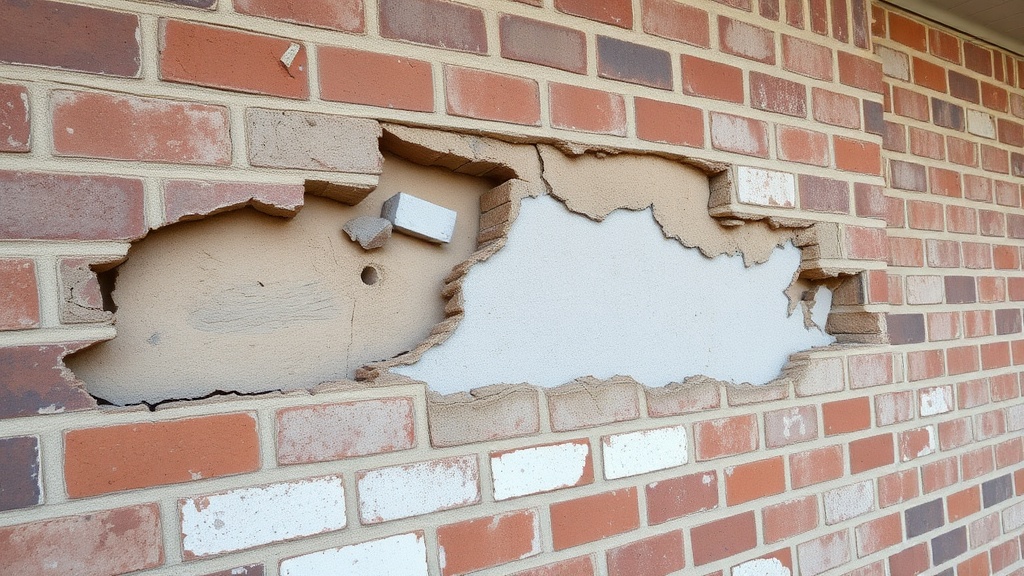
The homeowner reached out after noticing that brick faces had begun breaking away from the west elevation of their 1974 Colonial. Chunks of brick face were appearing in the mulch bed along that side of the house in clusters, and the underlying red-brown core of each damaged brick was exposed and rough to the touch.
When we assessed the wall, 19 bricks had spalled to the point of replacement. Another dozen showed surface crazing - hairline fractures radiating across the face - that indicated they were in the early stage of the same failure. The cause was not hard to identify. The west elevation had been repointed within the past five to eight years, based on the mortar color contrast and surface weathering difference between old and new joints. The repointing material was a Portland-heavy mix - lab-comparable to Type S, with an estimated compressive strength of 1,600 PSI or higher. The original brick on a 1974 Colonial of this construction type is a medium-density modular unit rated for Type N mortar at roughly 750 PSI maximum. The mismatch had driven all thermal and moisture movement stress directly into the brick face.
The previous contractor had created a wall that looked repaired from the street but was actively destroying the brick it was meant to protect.
Our Solution
We sourced 24 replacement bricks - 19 plus 5 spares - from a salvage supplier carrying discontinued 1970s-era modular brick. Color matching required reviewing three sample batches under different light conditions. The selected lot matched the warm tan-brown of the original west elevation brick within a visible shade under afternoon light.
Each spalled brick was removed using hand chisels and a cold chisel set, working carefully to avoid disturbing the brick courses above and below. Cavity edges were wire-brushed and dampened before setting. Replacement bricks were bedded in Type N mortar with a consistency between stiff and plastic - firm enough to hold position without slipping but workable enough to ensure full bed and head joint contact. Each replacement brick was back-buttered on three sides and set with consistent 3/8-inch joint spacing to match existing coursing.
After the replacements were set, we removed the existing Type S mortar from all remaining joints on the west elevation using a 4-inch grinder with a 1/8-inch diamond blade set to 3/4 inch depth. Those joints were repointed with the same Type N mortar used for the brick setting, tooled to a concave profile matching the original east elevation joints.
The Result
The 19 replacement bricks integrated cleanly with the surrounding wall. Within three months of weathering, the salvaged brick aged down to match the original units to a degree that is not visible from the sidewalk.
More critically, the incompatible mortar has been removed from the entire west elevation. The wall assembly can now flex appropriately with seasonal movement rather than driving stress into the brick face.