The Problem
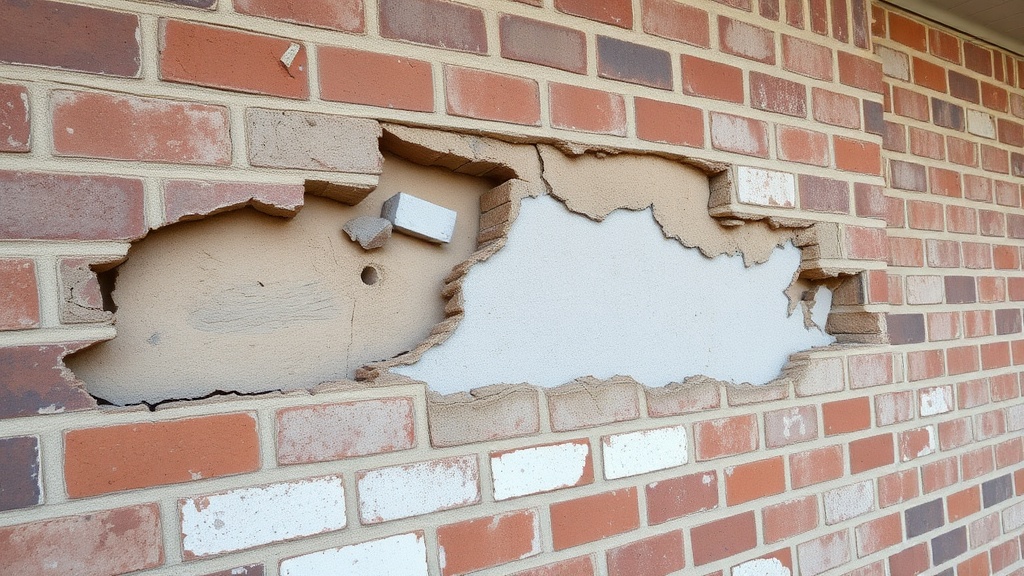
The homeowner in West Buffalo Grove called us after noticing several brick faces had popped off the front elevation of their 1995 subdivision home. Seven bricks near the garage opening had lost the outer face layer entirely, exposing the porous core beneath. Another cluster of eleven bricks along the foundation course showed deep horizontal cracks running through the face, a sign the brick had absorbed water, frozen, and expanded repeatedly over many Illinois winters.
Beyond the spalled units, the mortar joints across the lower four courses had softened noticeably. The original Type N mortar from 1995 had weathered down to a crumbly texture that released powder when pressed with a finger. Left alone, this combination of deteriorating brick and soft mortar creates an accelerating cycle: water enters the joint, saturates the brick behind it, and more spalling follows.
Our Solution
We sourced replacement brick from a local supplier that stocks builder-grade face brick commonly used in mid-1990s Lake County subdivisions. We brought color samples to the site before ordering and compared them against an undamaged course on the east wall, which sees less direct weather exposure. The match came within an acceptable range given the 30-year weathering difference between old and new brick.
All 38 damaged units were cut out cleanly, keeping the surrounding joints and adjacent bricks intact. New brick was set in fresh Type N mortar with joints packed to the same 3/8-inch profile as the original coursing. We then ground the soft mortar from the deteriorated lower courses to 3/4-inch depth and repointed with matched Type N. Each joint was struck with a slicker to match the slightly weathered profile of the original joints above, so the repaired section does not read as a hard patch line.
We applied a penetrating water repellent to the repaired section and the two courses above and below to slow future water infiltration without sealing the wall surface.
The Result
The front elevation is structurally sound and presents a consistent face. The new brick will weather slightly toward the original tone over the next two to three seasons. The mortar work below the window openings, where most of the joint deterioration was concentrated, is now solid and correctly profiled.
The homeowner has a record of the brick manufacturer and mortar specification so future repairs can be matched without guesswork.
Frequently Asked Questions
-
question: “Why did the brick faces pop off on a home only 30 years old?” answer: “Face brick spalling at this age usually points to a combination of factors: slightly porous brick fired at the lower end of hardness tolerance, north or west exposure that keeps the wall wetter longer, and joints that have softened enough to let water migrate behind the face. It is not unusual on 1990s builder-grade brick in Lake County.”
-
question: “Can the new brick be made to match perfectly?” answer: “A close match is achievable; a perfect match is rarely possible on aged brick. New brick starts noticeably cleaner and more uniform, but weathering narrows the difference within two to three seasons. We always compare samples on-site before ordering.”
-
question: “Do I need to seal the brick after the repair?” answer: “A penetrating water repellent on the repaired section is worth doing, especially on lower courses exposed to ground splash. It slows water entry without trapping moisture inside the wall, which is the failure mode of film-forming sealers on brick.”