The Problem
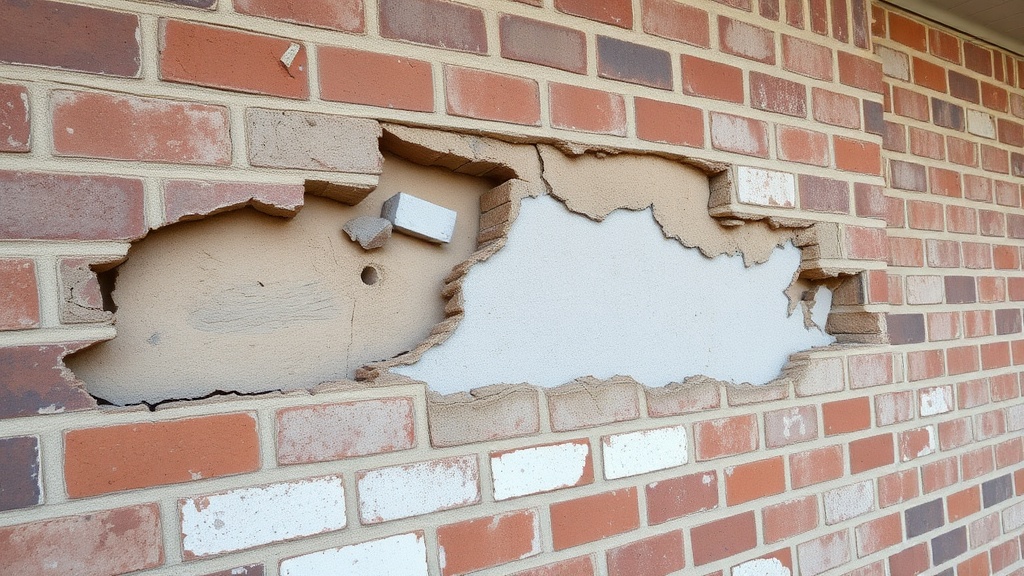
The owner of a 2001 brick estate home in Central Gurnee called us about a visible vertical crack running through the brick on the front elevation, near the inside corner where a projecting bay meets the main wall plane. The crack was clean and ran straight vertically through six mortar joints and two brick units, which is a pattern that points to thermal movement rather than settlement or impact.
Large brick veneer facades on estate-scale homes require control joints to allow for thermal expansion and contraction. The 2001 original construction had included a control joint at this inside corner location, but the joint had been filled with mortar during installation rather than left open and sealed with a backer rod and sealant as designed. A rigid mortar fill cannot function as an expansion joint; it transfers the thermal stress directly into the adjacent masonry, which is what produced the crack over 24 years of Illinois temperature cycles.
Our Solution
We removed the two cracked brick units and the mortar fill in the false control joint, working the full height of the bay intersection. The existing crack in the mortar joints was traced through its full length and the affected joints were ground out to sound material.
The 12 remaining displaced but uncracked bricks were removed carefully, cleaned of old mortar, and set aside for reinstallation. Two new replacement bricks were sourced from a supplier stocking the same manufacturer’s blend used extensively in Lake County estate construction around 2000. The color match on 25-year-old brick is always approximate; we compared samples against the shaded inner bay wall where weathering is minimal.
The control joint was rebuilt correctly: 3/4-inch open gap, foam backer rod sized to the joint width, and paintable polyurethane sealant applied in two passes to achieve full joint coverage. The surrounding 30 linear feet of mortar joints that had softened in the bay area were repointed with Type N mortar to match.
The Result
The vertical crack is closed and the thermal movement that caused it now has a functioning expansion joint to accommodate it. The repaired section is structurally sound and visually consistent with the surrounding facade.
The homeowner was advised that a second inside corner location on the east elevation shows early signs of the same stress pattern and should be monitored. If a crack develops there, the same control joint rebuild applies.
Frequently Asked Questions
-
question: “What is an expansion joint in brick veneer and why does it matter?” answer: “Brick expands and contracts with temperature changes. On large facades, this movement has to go somewhere. Expansion joints are designed gaps that allow the wall to move without cracking. If they are filled with mortar instead of flexible sealant, the movement forces a crack elsewhere - usually through the nearest weak point.”
-
question: “Can a brick that is cracked but still in the wall be left in place?” answer: “Only if the crack is shallow and the structural integrity of the unit is not compromised. Through-cracks that run the full thickness of the brick allow water to enter the wall cavity. We remove those units and replace them. A surface check crack that does not penetrate fully can often be sealed and left.”
-
question: “Why does the brick color not match exactly on a 25-year-old home?” answer: “The original brick has spent 25 years weathering in UV, rain, and temperature cycles. New brick starts from the manufacturer’s base color with no weathering. The gap narrows significantly within two seasons, especially on south and west facades with strong sun exposure.”