
Call Now Free Quote
(847) 713-1648 Get Free Estimate
Chimney Repair - Skokie, IL

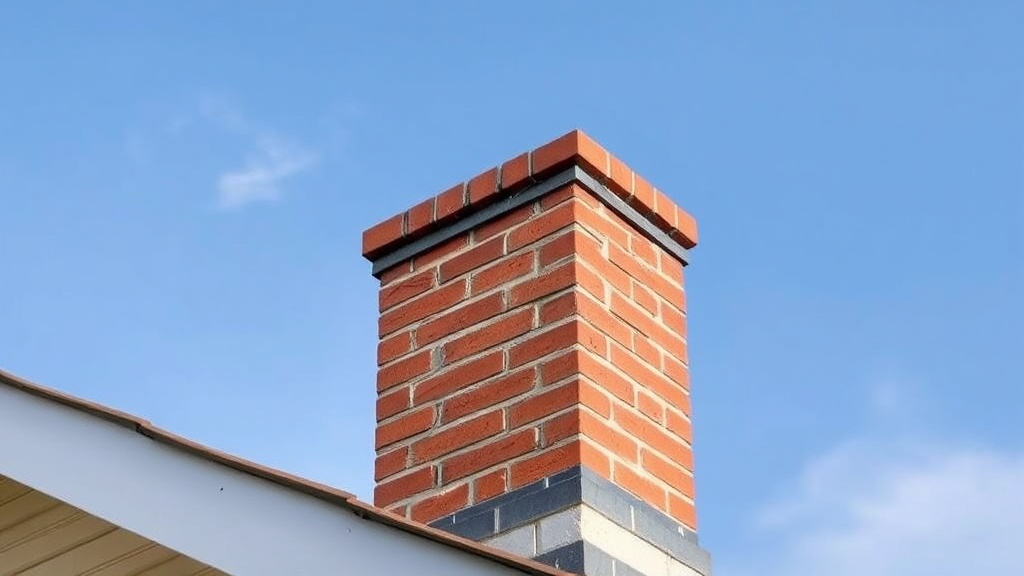
Shared Firebox Chimney Repointing - 1955 Brick Chimney

November 17, 2025 | West Skokie residential area

Before: Shared Firebox Chimney Repointing - 1955 Brick Chimney Before
After: Shared Firebox Chimney Repointing - 1955 Brick Chimney After
Location Skokie, IL
Service Chimney Repair
Scope Full repointing of all stack joints above roofline on double-flue 1955 chimney. Crown reseal. Step and counter-flashing inspection. Flue liner inspection from cleanout access.
Mortar Type Type N
Duration 3 days
Building 1955 brick chimney with shared firebox

The Problem

The owner of a 1955 ranch in West Skokie noticed an occasional smell of dampness near the fireplace after wet weather. The damper was working and there was no staining inside the firebox. On exterior inspection, the stack showed visible mortar recession across the upper two-thirds, most pronounced on the north and west faces.

This chimney is a double-flue stack, serving a shared firebox that opens into both the living room and the den. Both flues run through the same brick stack. On the roof, we confirmed joint recess averaging 5/8 inch on the north face and 1/2 inch on the west, with open joints near the top course. The crown was structurally intact but visibly porous - it had lost surface density and was absorbing water rather than shedding it.

Our Solution

We ground all stack joints above the roofline to 3/4-inch depth on all four faces, vacuumed out debris, and dampened the brick before packing. The mortar was Type N batched to match the original 1955 joint color - a medium gray with moderate sand aggregate. We tested against a sheltered north-face joint below the roofline where the original color was still legible, and confirmed the match after a 48-hour cure on a small test section.

All joints were packed in two lifts and tooled concave to match the lower unrepaired courses. At the top two courses where joint loss was most severe, we gave particular attention to full back-of-joint contact, where voids pool water most readily.

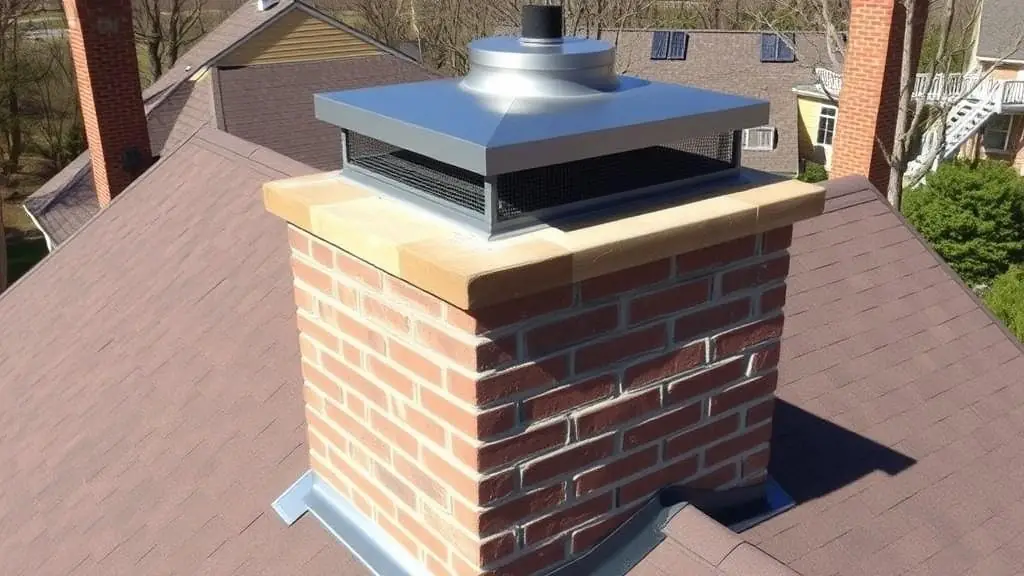
The porous crown received an elastomeric seal coat in two passes over the full surface, continuing 2 inches down the brick face at all four edges. This seals the crown surface and covers the crown-to-brick transition where hairline separation typically starts. No demolition was needed because the crown body remained structurally sound.

Both flue liners were inspected from the basement cleanout with a flashlight and camera extension. Neither showed active cracking or joint failure in the accessible clay tile sections. Liner condition was documented in writing.

The Result

The dampness smell did not recur through the following wet season. Stack joints are at uniform concave depth across all four faces. The sealed crown shows no surface water absorption at 60 days. The homeowners have written documentation of the double-flue liner condition.

Related: Chimney Repair Services | Skokie Service Area

Questions About This Project

What is a shared firebox chimney and does it present any special repair considerations?

Some postwar homes were built with a single firebox that vented into two separate flues within one chimney stack, allowing the fireplace to serve two adjacent rooms or a room and a basement. The shared firebox means the chimney has two clay tile flue liners running side by side. For repointing the stack, this does not change the exterior repair process. It does mean that a flue liner inspection needs to check both liners, not just one, since each can crack or deteriorate independently.

The crown on the 1955 chimney is intact but stained and porous. Does it need to be replaced or can it be sealed?

An intact crown without structural cracking or separation from the brick face can often be stabilized with an elastomeric crown seal rather than full demolition and replacement. The seal penetrates the crown surface, bonds hairline fissures, and creates a flexible waterproof layer that accommodates the crown's thermal movement without cracking the way a rigid coating would. The threshold for recommending replacement versus sealing is the presence of through-cracks or crown-to-brick gap - either one means the crown is no longer doing its job and sealing alone will not fix it.

How often should a 1955 chimney be inspected even if it looks fine from the ground?

A chimney of this age that is actively used for heating should be inspected every two to three years. The areas of concern - crown condition, flashing seal, stack joint depth, and flue liner integrity - cannot be evaluated from ground level. A basic visual inspection from the roofline takes under an hour and identifies conditions before they result in interior water damage or, in the case of liner failure, carbon monoxide risk. Chimneys on homes of this era are 70-year-old structures and benefit from regular, scheduled attention.

Project Location

Loading map - 1 project in this area

Need Similar Work? Let's Fix It Right.

Free on-site inspection and written estimate - no obligation. Serving the North Shore and Chicagoland for over 39 years.

(847) 713-1648 Request Online Estimate