
The Problem
The homeowners on this 1908 estate near Sheridan Road in East Kenilworth contacted us after a decade-old prior repointing job had begun showing clear signs of failure. The south and east elevations, which had been repointed in the 1970s with a Portland-heavy mix, were cracking along the joint lines and showing early face fracturing on adjacent limestone units.
The original mortar on a home of this age and material would have been a natural lime or early hydraulic lime product - far softer and more permeable than the Portland-based mortar applied decades later. That mismatch in stiffness is well understood in historic masonry work: when the mortar is harder than the stone, the stone absorbs the stress, and fracturing follows. The north and west elevations, which had retained the original mortar, were in significantly better condition despite being 70 years older than the failed repointing.
The problem was not the age of the home. It was the wrong mortar applied by the prior contractor.
Our Solution
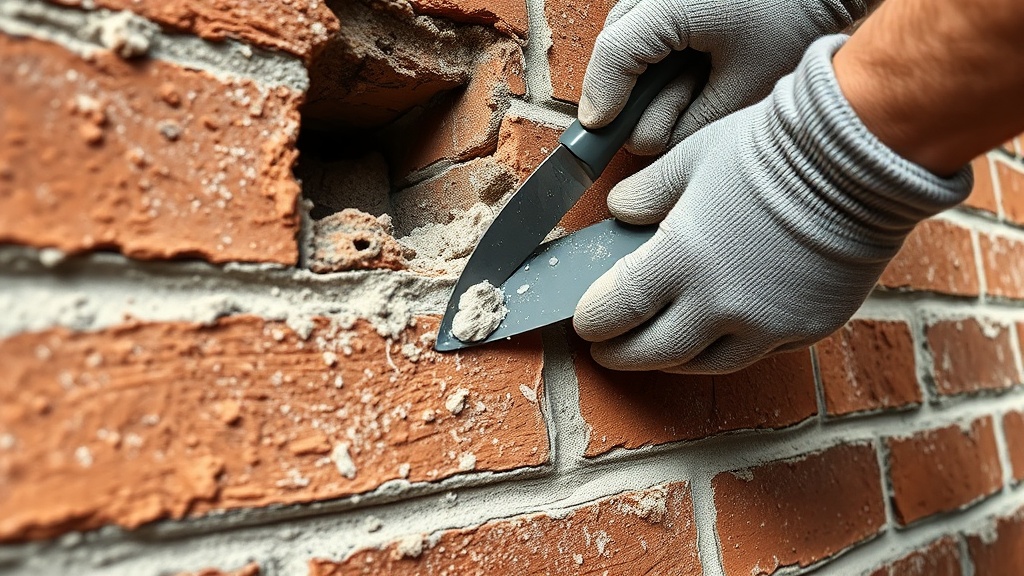
We began by removing all of the 1970s Portland-based repointing on the south and east elevations. This required hand chisels rather than angle grinders in most locations, because the limestone units had tight joint widths of approximately 3/8 inch and the adjacent stone faces were already stressed. Mechanical grinding at those dimensions creates enough vibration to propagate existing micro-fractures.
On the north and west elevations, where original mortar remained, we selectively removed only joints that had recessed beyond 1/2 inch or shown visible cracking, leaving sound original mortar in place.
The replacement mortar was NHL 3.5 natural hydraulic lime, dry-mixed on site and gauged with clean water to a stiff, non-slumping consistency. NHL 3.5 sets through a hydraulic reaction that does not require CO2 to carbonate, making it appropriate for the partially sheltered joints on the north elevation where airflow is limited. We tooled all new joints to a square-cut flush profile matching the original stone edge detail visible on protected interior joints.
Carbonation bloom on 22 limestone units on the south face was cleaned before final joint work to prevent the new mortar from bonding to a contaminated surface.
The Result
At 340 linear feet completed over two weeks, the mortar condition across all four elevations is now uniform. The south and east elevations no longer show the visible joint cracking that had been the homeowners’ initial concern, and the replacement NHL 3.5 joints are visually consistent with the original mortar retained on the north and west faces.
We documented each of the 14 limestone units that showed pre-existing stress fracturing from the 1970s work. All remain in place and stable. The homeowners now have a baseline record for future inspections.