The Problem
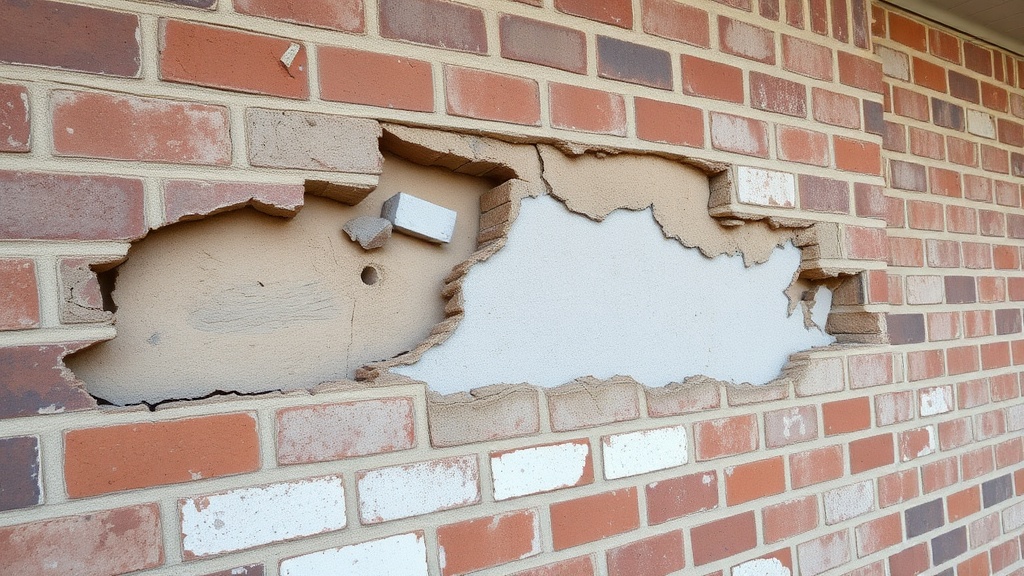
The homeowner had grown up in this 1964 brick ranch in South Libertyville and taken over the property from her parents. The home had been well maintained in other respects, but the face brick veneer had never been addressed. When she contacted us, the primary concern was the front facade, where a significant number of brick units were spalling on the face and several header course units above the living room windows appeared to be separating from the wall.
We inspected and found 48 brick units across the front and garage facades with spalling ranging from surface crazing to 1/2-inch-deep face loss. The header course above the living room window had mortar recession of 7/8 inch at the head joints on three consecutive units, and one unit showed lateral movement of approximately 1/4 inch out of plane, indicating the mortar bond had failed on both bed joints.
The steel lintel above the garage door was also showing surface rust scale and had transferred a rust stain into the brick course immediately above it. The staining alone does not indicate structural failure, but the rust scale was contributing to mortar joint pressure against the brick at the lintel bearing points.
The existing mortar throughout the undamaged sections was a standard grey Type N, consistent with 1960s construction practice.
Our Solution
We sourced 48 replacement brick units from two regional suppliers. The best color match came from a Libertyville masonry yard that carries discontinued regional production from the 1960s suburban build-out period. The garage facade units were a closer match than available for the front, so we prioritized the best units for the front and used the secondary match on the garage where they would be less visible from the street.
The spalled and displaced units were removed by hand after scoring the surrounding joints. For the displaced header course unit, we propped the course above before removal using a steel flat bar and timber block, then reset the header and two adjacent stretchers as a unit once the cavity was cleaned.
Replacement mortar was Type N at a 1:1:6 ratio (Portland, masonry lime, medium grey sand) to match the existing joint tone. All new joints were tooled with a concave jointer to match the original profile, which was a standard rounded bead common to 1960s residential work.
The steel lintel was wire-brushed to remove rust scale, treated with a rust-inhibiting primer, and the mortar at the lintel bearing points was ground out 1 inch and repacked to relieve the pressure buildup from the rust swelling. The rust staining in the brick above was not addressed as it is cosmetic and will weather over time.
The Result
All 48 replacement units were set and pointed in four days. The header course above the living room window is plumb and fully bedded. The displaced unit is back in plane.
The lintel is cleaned, primed, and repointed at the bearing points. We recommended the homeowner have it inspected again in five years as part of routine maintenance.
The homeowner noted that the repaired facade is in better visible condition than it has been since she can remember.