The Problem
The homeowners purchased this 1924 Chicago bungalow in Downtown Libertyville three years prior and inherited a patching job done by the previous owner’s contractor. The patches were clearly Portland cement: grey, hard, and visibly cracked where they met the original cream-colored mortar joints.
When we inspected, the damage from those patches was already measurable. On the front facade, six brick units adjacent to the Portland patches showed surface spalling ranging from 1/8 inch to 3/8 inch deep. Three units had lost enough face that the fired interior of the brick was exposed. The patches themselves were bridging across two or three joints in some locations, locking sections of the facade into a rigid block that moved as a unit rather than allowing individual brick to accommodate thermal expansion.
The original mortar in undisturbed sections was a pale cream lime putty mix with coarse natural sand. Probe testing in those sections showed sound bond at 1/2 inch depth. The problem was entirely confined to the patched areas and the brick immediately adjacent.
Our Solution
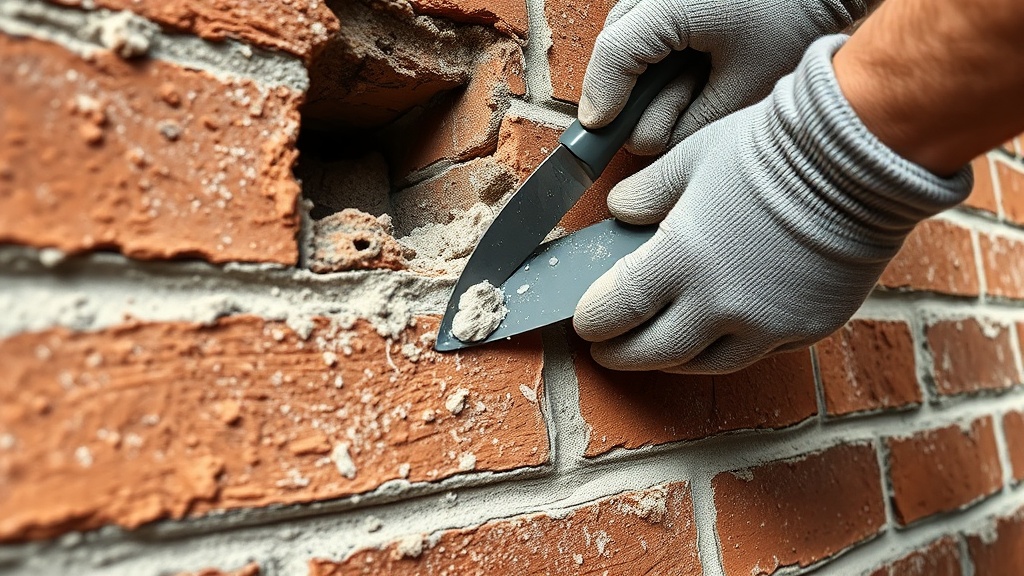
We removed all Portland patches using a combination of oscillating multi-tool cuts along the patch edges and careful hand chisel work to break the patch free without widening the joint beyond its original dimension. On three units where the Portland had bonded to the brick face, we accepted a slight surface irregularity rather than risk further spalling by forcing the removal.
After patch removal, we surveyed the full front facade and south return for any additional joint deterioration. Total repointing scope was 210 linear feet, including both the patched sections and areas of original mortar recession found during the survey.
Replacement mortar was mixed as a Type O lime-rich blend: one part Portland, two parts masonry lime, and nine parts coarse natural sand. The sand was a buff-cream color sourced from a regional masonry supplier to approximate the original aggregate tone. This ratio produces a mortar softer than the original brick, which is the correct relationship for Chicago common brick.
Joint preparation used a 3-inch oscillating grout saw in all areas where the joint width allowed it, switching to an angle grinder with a 1/8-inch blade only on open joints where blade-to-brick clearance was adequate. Depth held to 3/4 inch throughout, checked with a depth stop gauge.
The three spalled brick faces were stabilized with a thin skim coat of Type O mortar to even the surface. This is not a structural repair but prevents further moisture infiltration at the exposed interior.
The Result
All Portland patches were removed. The full 210 linear feet of repointing was completed in five days. The cream-colored Type O mortar matches the original undisturbed joints closely across both facades.
The spalled brick units are stabilized. The homeowners understand those units may need replacement in a future maintenance cycle but are not a water infiltration risk in their current condition.
We provided a written record of the mortar mix and the locations of stabilized brick units for their future reference.